
Commercial Double Door Repair Toronto: Astragals, Flush Bolts, Coordinators & Panic Bars (2026)
A pair of doors is more than two single doors side by side. The inactive leaf, the astragal, the flush bolts and the coordinator all have to work together, and when one of them is off the whole opening stops latching, sealing or locking. We repair pairs of steel, hollow metal and aluminum doors for businesses across Toronto and the GTA.
Fix Your Double Doors
Tell us what the pair is doing: not latching, closing out of order, a gap in the middle, or a bolt that won't drop. Photos of the top and bottom of the doors help.
No obligation. We reply quickly, 24/7.
How a Commercial Pair of Doors Works
Knowing the parts makes the problem easier to find.
Most commercial double doors have an active leaf, the one people normally push or pull, and an inactive leaf that stays shut most of the time and only opens for deliveries, equipment or a wide emergency exit. The two leaves meet in the middle, and how they meet decides whether the pair latches, seals and locks.
The astragal
An astragal is the metal strip fastened along the edge of one leaf that covers the gap where the two doors meet. It blocks drafts, light and prying tools, and on fire-rated pairs it is often a required part of the assembly. A bent or loose astragal is one of the most common reasons a pair suddenly stops closing.
Flush bolts
Flush bolts are set into the edge of the inactive leaf, one at the top and one at the bottom. When they are thrown, the inactive leaf is locked into the frame head and the floor, and the active leaf latches against it. Manual flush bolts are slid by hand; automatic and constant-latching flush bolts throw themselves when the door closes.
The coordinator
If both leaves have closers and there is an overlapping astragal, the inactive leaf must close first. A coordinator is the bar mounted under the frame head that holds the active leaf open until the inactive leaf has closed. Without a working coordinator, the active leaf closes first, the astragal hits, and the pair is left open.
Exit devices on a pair
Exit doors in pairs use either two vertical rod devices, a vertical rod and a rim device with a removable mullion, or a mullion with two rim devices. Each setup has its own adjustments, and a pair that worked for years can start failing when one rod or latch wears.
The whole opening
We check both leaves, the frame, the closers and every latch point, not just the part that broke.
Locks and exits
Flush bolts, panic bars, vertical rods and locks adjusted to work as a set.
Commercial doors
Steel, hollow metal and aluminum pairs in offices, plazas, warehouses and buildings.
Common Double Door Problems We Repair
What we find on service calls, and what each one usually means.
The pair won't latch
The active leaf bounces off the inactive leaf, or the latch misses the strike in the middle.
Doors close in the wrong order
The active leaf closes first and the astragal stops the inactive leaf from shutting.
Gap in the middle or uneven tops
One leaf has dropped on its hinges, so the two doors no longer line up.
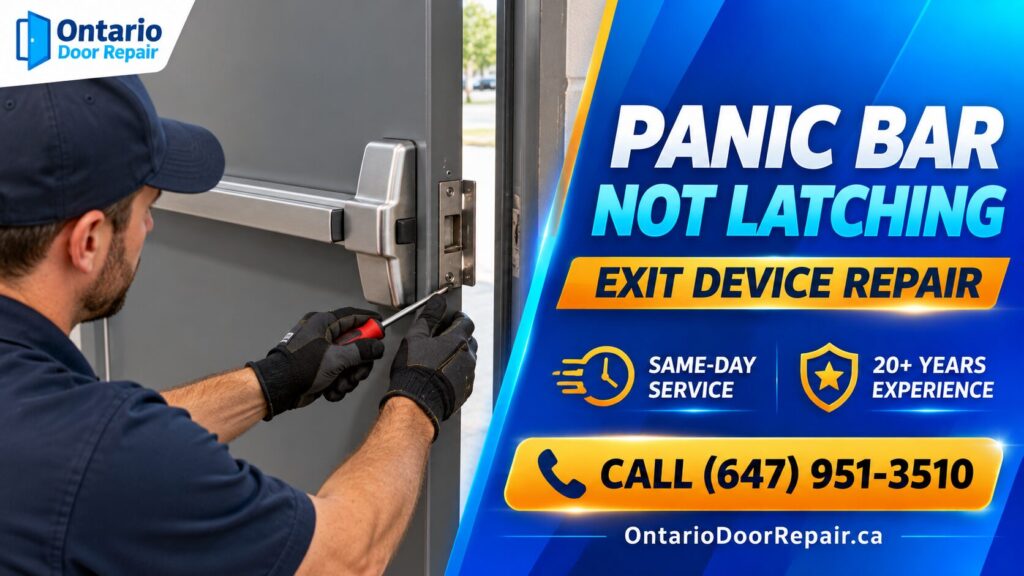
Panic bar on the pair won't latch
Vertical rods, top latches or the mullion are out of adjustment or worn.
Flush bolt stuck or broken
The bolt won't slide, won't stay up, or the floor strike is packed with dirt and salt.
Astragal bent or torn off
Carts, forklifts and forced entry bend the astragal so it hits the other leaf.
Closer leaking or slamming
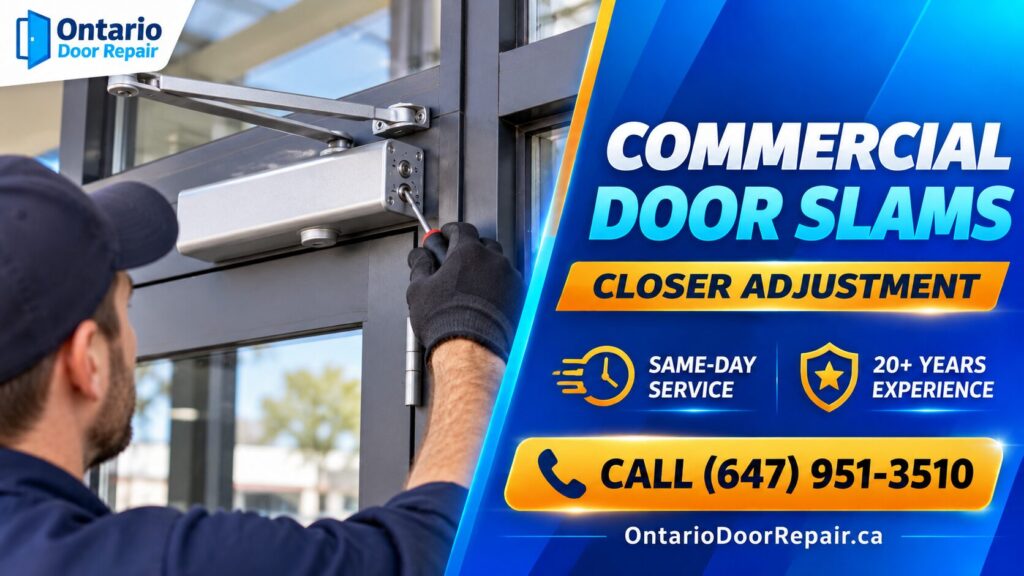
One closer has failed, so one leaf slams or drifts and the pair loses its timing.
Fire-rated pair failing inspection
A missing coordinator, damaged astragal or wedged-open leaf is a common inspection finding.
Pair won't lock at night
The inactive leaf isn't held by its bolts, so the lock on the active leaf has nothing solid to lock against.
Double doors not closing at closing time?
We come out the same day to get the pair latching and locking. Available 24/7 across Toronto and the GTA.
Why Pairs of Doors Go Out of Adjustment
Most problems build up slowly, then show up all at once.
Weight and hinges
Each leaf of a commercial pair is heavy, and its hinges carry that weight on every swing. Over time the screws loosen and the hinges wear, the leaf drops, and the two doors stop meeting evenly in the middle. A small drop on one leaf is enough to stop the astragal clearing or the top bolt lining up with its strike.
Traffic and abuse
Back and side pairs at plazas, restaurants and warehouses get pushed open with carts, pallets and hand trucks. The astragal takes the hit, the inactive leaf gets forced while its bolts are thrown, and the floor strike gets damaged. Read more on commercial back doors.
Winter
Salt and slush fill the bottom flush bolt strike, so the bolt can't drop. Cold thickens closer fluid so leaves close slower, which upsets the timing between the two leaves. Steel frames move with temperature. A pair that was fine in September can stop latching in January. See winter-proofing commercial doors.
Someone adjusted one door
A common one: a closer gets sped up on one leaf to stop a draft, and now the active leaf beats the inactive leaf every time. On a pair, both closers and the coordinator have to be set together.
Flush Bolts: Manual, Automatic and Constant Latching
Which one you have changes how the pair behaves.
Manual flush bolts
- Slid up and down by hand
- Simple and inexpensive
- Leaf is only secure if staff remember to throw them
- Common on storage rooms and back doors
- Not suitable where both leaves must open for exit
Automatic and constant-latching bolts
- Throw themselves when the leaf closes
- The pair locks without anyone remembering
- Used with coordinators on fire-rated pairs
- Need correct adjustment to release properly
- Floor strike must stay clean
If the inactive leaf of your pair is meant to be used as an exit, manual bolts may not be the right hardware for it. Exit requirements depend on the building and the door, so we look at how the opening is used before recommending a change. For exit hardware in general, see panic bar repair and fire exit doors.
How We Repair a Commercial Pair
The order matters: hang the doors right before adjusting the hardware.
1. Check the frame and hinges
Both leaves are checked for sag, loose hinges and a frame that has moved. Doors are rehung first.
2. Align the meeting edges
The leaves are adjusted so they meet evenly top to bottom and the astragal clears.
3. Bolts and strikes
Flush bolts and their head and floor strikes are cleaned, adjusted or replaced.
4. Closers and coordinator
Each closer's speed is set and the coordinator is adjusted so the inactive leaf always closes first.
5. Latches and exit devices
Locks, latches, rods and panic bars are adjusted to the newly aligned pair.
6. Test from full open
Both leaves are opened fully and released, several times, to confirm they close, latch and lock every time.
Steel, Hollow Metal and Aluminum Pairs
The door type changes what can be repaired.
Steel and hollow metal pairs
Found on back exits, mechanical rooms, warehouses and stairwells. They are heavy, so hinges and frames take a lot of load. Bent edges, rusted bottoms and torn-out hinge screws are common. When the frame itself is damaged, see hollow metal door and frame replacement.
Aluminum storefront pairs
Common at plaza and retail entrances. Many hang on pivots or continuous hinges, use narrow-stile locks, and close with overhead or floor closers. See storefront floor pivot repair and storefront door hinge repair.
Fire-rated pairs
Corridor and stairwell pairs in many buildings are fire-rated assemblies. The doors have to close and latch on their own, and the astragal, coordinator and bolts are part of how they're tested. Replacement parts have to suit the rating. See fire-rated door requirements.
Repair or Replace the Pair?
Most pairs can be repaired.
Repair makes sense when
- The frame is straight and solid
- The doors are flat and not rusted through
- The problem is hinges, bolts, closers or adjustment
- Parts for the hardware are available
- The pair worked well until recently
Replacement is worth looking at when
- The frame is bent, split or rusted at the floor
- The doors are rusted through at the bottom
- The pair was damaged in a break-in or vehicle impact
- Hinge areas are torn out repeatedly
- You're changing the opening size or hardware completely
For pricing factors, see the commercial door repair cost guide. For ongoing upkeep across a building, see commercial door maintenance.
Simple Checks for Property Managers
Five minutes a month catches most problems early.
- Open both leaves fully and let go. The inactive leaf should close first, and both should latch without a push.
- Look at the top of the pair. The leaves should be level with each other and the gap in the middle even.
- Check the floor strike. Clear out salt, sand and debris so the bottom bolt can drop fully.
- Look for oil. Oil on a closer or the floor below it means the closer is failing.
- Pull on the inactive leaf with its bolts thrown. It shouldn't move.
- Never prop fire-rated pairs open with wedges or by disabling the closer.
Related Commercial Door Services
Often part of the same visit.
Commercial door repair
Steel, aluminum and glass doors for businesses.
Panic bar repair
Exit devices that won't latch or release.
Door closer repair
Leaking, slamming and slow closers.
Door alignment
Doors that rub, drag or won't close.
Continuous hinges
For heavy, high-traffic doors.
Steel door repair
Bent, rusted and damaged steel doors.
Commercial Double Door FAQ
Questions building owners and managers ask.
Why does the active door bounce back open?
Usually because it closes before the inactive leaf, or the inactive leaf isn't held by its bolts. The coordinator and flush bolts are the first things we check.
What is a coordinator and do I need one?
A coordinator holds the active leaf until the inactive leaf has closed. It's needed when both leaves have closers and an overlapping astragal, and it's common on fire-rated pairs.
Can you fix a bent astragal?
Often it can be straightened and refastened. If it's torn or badly bent, it's replaced with one that suits the door.
The bottom flush bolt won't drop. Is it broken?
Very often the floor strike is packed with dirt or salt. Cleaning it fixes the problem. If the bolt itself is worn, it's replaced.
Can both doors of a pair have panic bars?
Yes. Pairs can use vertical rod devices, or rim devices with a removable mullion. Which one suits depends on the door and how it's used.
Do you repair aluminum storefront double doors?
Yes, including pivots, continuous hinges, narrow-stile locks and closers on storefront pairs.
Are you available after hours?
Yes. We offer 24/7 emergency service for doors that won't lock or close.
Can I send photos first?
Yes. Send photos of the top and bottom of the pair to our WhatsApp at 647-866-0956.
More Commercial Door Guides
Related help from our team.
Commercial Door Repair Across the GTA
Local pages near your building.
Double doors that close, latch and lock every time
Commercial pairs of doors repaired for businesses and buildings across Toronto and the GTA. Licensed, insured and available 24/7.
📞 Call 647-951-3510 Request a Free Estimate