Every fall we get the same call. The door closed fine all summer, then the first cold snap hits and suddenly it will not latch, there is a draft you can feel from the couch, and the deadbolt turns like it is full of sand. Winter does not create new door problems in Toronto so much as it exposes the ones that were already there. This guide walks through what actually goes wrong on GTA doors between November and March, what you can fix yourself in an afternoon, what needs a technician, and what each repair typically costs in 2026.
Why Toronto Winters Are So Hard on Doors
The GTA gives doors a brutal ride. A single January day can swing from -18C outside to +21C inside, which means the outer face of your door is contracting while the inner face is expanding. Add road salt, freeze-thaw cycles, and the fact that most exterior doors here sit in frames that have shifted a few millimetres since the house was built, and small tolerances disappear fast.
Wood is the most reactive material. A solid wood slab can move several millimetres across its width between a humid August and a dry February, which is exactly why a door that sticks in summer can rattle in winter, and the other way round. We covered the summer half of that cycle in why doors stick in summer. Steel and fiberglass move far less, but their frames, hinges and hardware still shift with the building.
The pattern repeats across Etobicoke, North York and Scarborough every year: a door that was slightly off in the fall becomes unusable by the second cold week. Deal with it now and you are looking at an adjustment. Wait until it will not lock in February and you are often looking at frame work.
Problem 1: Cold Drafts Around the Entry Door
What is actually happening
Weatherstripping is a compression seal. It works by being squeezed between the door and the stop every time the door shuts. After five to ten Toronto winters the foam or bulb takes a permanent set, stops springing back, and leaves a gap you can slide a business card through. The bottom sweep goes first, because it takes the most abuse from boots, salt and grit.
How to test it in two minutes
Close the door on a strip of paper and pull. If it slides out with almost no resistance, that spot is not sealing. Do it at the top corners, both mid-stiles, the latch side and the bottom. Another option: on a windy day, run a lit incense stick slowly around the perimeter and watch where the smoke bends.
The fix and what it costs
If the slab is straight and the frame is square, this is a straightforward weatherstripping replacement, typically $120 to $280 supplied and installed for a standard residential entry door in the GTA. If the draft is only at one corner, though, weatherstripping is the symptom rather than the cause. That usually means the door is not sitting square in the frame, and new foam will just compress unevenly and fail again in a season.
Feeling a draft before winter even starts?
We can seal it now for a fraction of what a January emergency call costs. Same-day service across Toronto and the GTA.
Problem 2: The Deadbolt Will Not Line Up With the Strike Plate
Why it only happens when it is cold
This is the single most common winter callout we get. In cold weather the frame contracts, the house settles slightly differently on frozen ground, and the hinge side drops a millimetre or two. That is all it takes for the bolt to catch the edge of the strike instead of sliding into it. People compensate by lifting or shouldering the door to lock it, which loads the hinges and makes the drop worse.
What you can try
Close the door and look at the reveal, the gap between slab and frame, along the top and the latch side. It should be even, roughly the thickness of a nickel, all the way around. If it is wider at the top of the latch side and tighter at the bottom, the door has sagged. Start by tightening every hinge screw. On many GTA homes the top hinge is fastened into the jamb only and not the framing behind it, and swapping two of those short screws for 75 mm screws that bite into the stud will pull the door back up on its own.
When it needs a technician
If tightening does not recover the reveal, the fix is hinge shimming, a strike plate reposition, or frame realignment. Expect roughly $145 to $320 depending on how far out of plumb it is. Do not simply file the strike plate opening bigger. It buys you one season and leaves the bolt with less engagement, which is a real security downgrade and the opposite of the front door security upgrades you actually want.
Problem 3: Frozen and Sticky Locks
A lock cylinder that turns fine in October and seizes in January almost always has moisture in it. Moisture gets in, freezes, and the pins cannot move. The other cause is the wrong lubricant: anything oil based, including WD-40, attracts dust and grit that turns into a paste in the cold.
The correct product is a dry graphite or PTFE lubricant made for locks. A small puff into the keyway once in the fall is enough for the season. If a cylinder is already frozen, warm the key with your hands or gently with a lighter and work it in slowly. Never force a key in a frozen lock and never pour hot water on it, because you will either snap the key or push more water into the mechanism.
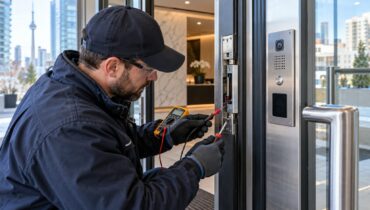
On commercial entrances the equivalent problem is an electric strike or maglock that starts behaving erratically once the vestibule gets cold. That is usually a voltage or alignment issue rather than ice, and it is worth diagnosing before a tenant is locked out at 6 a.m.
Problem 4: Frost and Condensation on the Inside of the Door
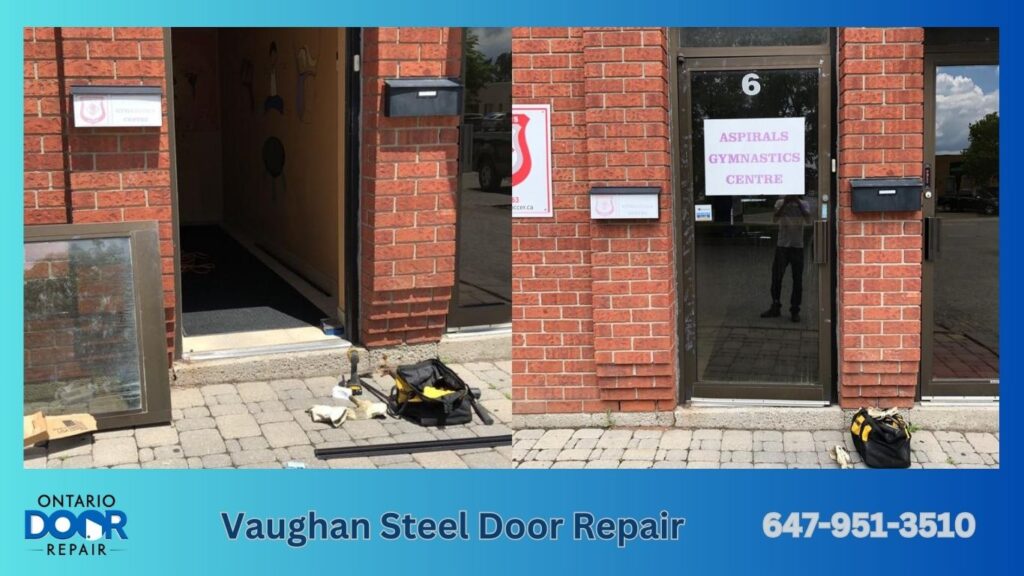
Waking up to frost on the inside of your steel door looks alarming, but it is physics rather than a defect. When the inner surface drops below the dew point of the air in your hallway, moisture condenses on it and then freezes. It tells you two things: the door is losing a lot of heat, and your indoor humidity is high.
On a well sealed insulated door you might get light condensation in a cold snap. Heavy, repeated frost usually means either a broken thermal break in the slab or, more often, that cold air is getting past the seal and chilling the whole panel. Left alone, that meltwater runs down and sits at the bottom rail, which is exactly how door frame rot starts in wood frames.
Short term: run the bathroom and kitchen fans, keep indoor humidity around 30 to 40 percent in deep winter, and wipe the panel down. Long term: fix the seal, or if the slab itself is the problem, look at whether repair or replacement makes more sense.
Problem 5: The Door Swings Open or Slams Shut on Its Own
A door that drifts open once the heat comes on is telling you the hinge barrels are not plumb. Sometimes it is the house and sometimes it is a hinge that was never shimmed correctly. There is a genuine field fix: pull the middle hinge pin, put a slight bend in it with a hammer against a hard surface, and reinstall. The friction holds the door where you leave it.
The commercial version is more serious. Door closers use hydraulic fluid, and fluid thickens in the cold. A closer tuned for July will be sluggish in January, leaving fire doors that do not latch, which is a code problem and not just an annoyance. Seasonal commercial door closer adjustment takes minutes and is one of the highest value maintenance items on any commercial entrance. If it is a rated assembly, see our notes on fire-rated door code requirements in Ontario.
Problem 6: Sliding Patio Doors That Ice Up and Bind
Patio doors have a lower track that collects water, and in a Toronto winter that water freezes. Rollers then drag over ice, flat-spot themselves, and by spring the door needs two hands and a shoulder. The track also traps grit and salt that grinds the rollers down.
Before the freeze, vacuum the track, wipe it dry, and check that the weep holes at the outside edge are clear so meltwater can escape instead of pooling. If the door already drags, do not force it, because that is how you bend the track lip. Details are in our sliding patio door track repair guide, and we cover general patio door repair across the GTA.
Problem 7: Garage Doors in Sub-Zero Weather
Torsion springs are steel under enormous tension, and steel gets brittle as it gets colder. That is why so many springs snap on the first genuinely cold morning of the year, usually right as someone is leaving for work. Cold also thickens the grease in the opener rail and makes the safety sensors more sensitive to frost and misalignment.
Before winter: lubricate rollers, hinges and the torsion bar with a proper garage door lubricant rather than grease. Check the bottom seal, because if it is cracked, meltwater will freeze the door to the slab and the opener will strain against it. Costs and timing are broken down in our garage door spring repair cost guide and general garage door services.

Winter Door Repair Costs in Toronto and the GTA (2026)
These are typical ranges we see across the GTA. Final pricing depends on door type, hardware, access and how much frame work is involved, and we confirm it on site before starting.
| Job | Typical 2026 range |
|---|---|
| Weatherstripping and bottom sweep replacement | $120 – $280 |
| Hinge tightening, shimming and door realignment | $145 – $320 |
| Strike plate reposition and latch adjustment | $110 – $220 |
| Lock cylinder service or replacement | $140 – $380 |
| Commercial door closer adjustment or rebuild | $180 – $550 |
| Sliding patio door roller replacement | $250 – $600 |
| Exterior frame repair or partial jamb replacement | $400 – $1,200 |
| After-hours emergency call-out | Premium on top of the repair |
For a full breakdown by door type, see our residential door repair cost guide and the commercial door repair cost guide. You can also request a free estimate and we will give you a number before any work starts.
The Fall Checklist: Fifteen Minutes That Saves a February Emergency
- Walk every exterior door and check the reveal is even top to bottom.
- Tighten all hinge screws, and replace two top-hinge screws with 75 mm screws into framing.
- Paper-test the weatherstripping at eight points around each door.
- Check the bottom sweep for tears, gaps and compression.
- Puff dry graphite or PTFE lubricant into every exterior cylinder.
- Confirm each deadbolt throws fully without lifting the door.
- Vacuum and dry sliding door tracks, then clear the weep holes.
- Lubricate garage door rollers, hinges and the torsion bar.
- Inspect the bottom of wood frames for soft spots and peeling paint.
- On commercial doors, test that every closer latches the door fully.
- Re-caulk any gap between the frame and the exterior cladding.
If anything on that list fails and you would rather not chase it yourself, we run pre-winter door service visits across the GTA. Book one in the fall and it costs a fraction of what the same door costs at 11 p.m. in a snowstorm through emergency door repair.
DIY or Call a Pro?
Do it yourself: tightening hinge screws, swapping a bottom sweep, lubricating locks and rollers, clearing tracks, adjusting a strike plate by a millimetre or two, and re-caulking.
Call us: anything where the door has dropped and will not come back with screws, any frame that is soft or split, multi-point locks that bind, glass that is cracked or fogged in an aluminum glass door, closers on fire-rated assemblies, and any door that will not lock at all. That last one is not a maintenance issue, it is a security one, in the same category as break-in and board-up repairs.
More warning signs are listed in the top 10 signs your door needs immediate repair and in our overview of the most common door problems in the GTA. If yours is already sticking, here is how we approach jammed doors.
Winter Door Problems by Door Type
Wood doors. The most movement, the most rot risk at the bottom rail, and the most likely to need seasonal adjustment. See wood door repair.
Steel doors. Stable slabs, but prone to interior condensation and to rust at the bottom edge where salt collects. See steel door repair.
Fiberglass doors. The best cold-weather performers overall. Problems are usually hardware or frame related rather than the slab itself.
Commercial storefront doors. Aluminum conducts cold aggressively, so pivots, closers and thresholds all need attention before winter. See storefront entry doors, pivot hinge replacement and fire exit doors.
Whatever the type, we handle both residential and commercial work, including full door repair and installation and front door replacement.
Frequently Asked Questions
Why does my door only stick in the winter?
Because the frame is contracting and the house is settling slightly differently on frozen ground. The door is not swelling in winter, the opening is changing shape around it. That is why the fix is usually alignment rather than planing the slab.
Can you replace weatherstripping when it is below freezing?
Yes. Most modern weatherstripping installs fine in cold weather. Adhesive-backed products are the exception, since the adhesive needs a warmer surface, so we use mechanically fastened seals when it is cold out.
My lock is frozen. What should I not do?
Do not force the key, do not pour hot water on it, and do not spray WD-40 into the cylinder. Warm the key gently instead, and once it is working, flush the cylinder with a dry graphite or PTFE lock lubricant.
Is frost on the inside of my door a defect?
Not necessarily. It usually means the door is losing heat and your indoor humidity is high. Heavy repeated frost is worth investigating, because the meltwater is what eventually rots the frame.
Do you offer emergency service in winter?
Yes. We run 24/7 same-day and emergency service across Toronto and the GTA, including doors that will not lock or close after a break-in or storm damage.
Should I repair or replace a door that fails every winter?
If the slab is sound and the problem is alignment or seals, repair is almost always the better value. If the slab is warped, delaminated or rotted through, replacement usually wins. We will tell you honestly which one you are looking at.
Winter Door Repair Across Toronto and the GTA
We service Etobicoke, North York, Scarborough, Vaughan, Markham, Richmond Hill, Mississauga, Oakville, Hamilton and the surrounding GTA, with 24/7 availability through the winter. Ontario Door Repair has been doing this for over 20 years, we are licensed and insured, and every job carries a warranty. You can read what our clients say or check the FAQ for anything we have not covered here.
Get it fixed before the first deep freeze
Drafts, doors that will not latch, frozen locks, sliding doors that bind. We handle all of it, same day, across Toronto and the GTA.